
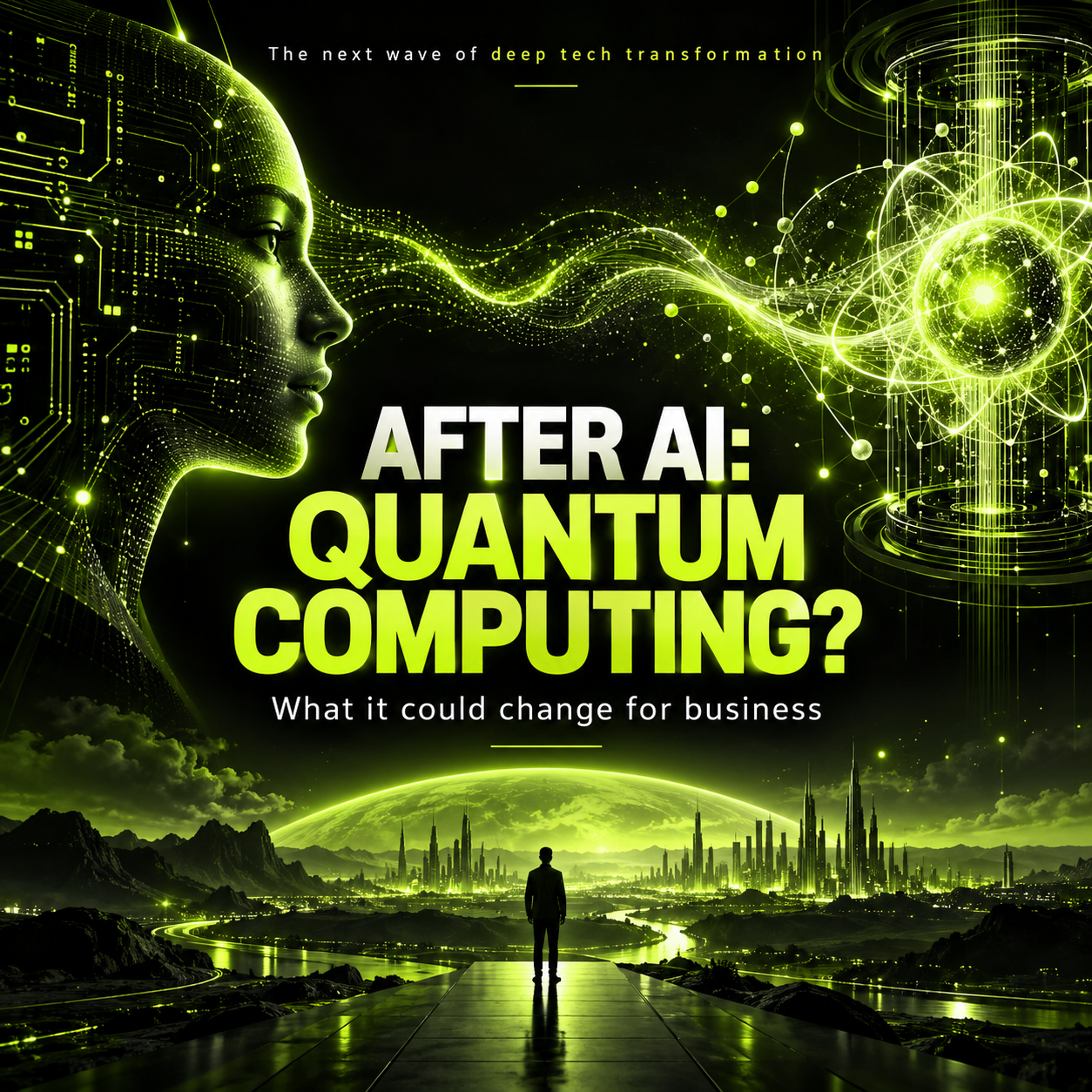
After AI, What Comes Next? Quantum Computing and the Future of Business
How quantum computing, artificial intelligence and hybrid systems could transform industries, cybersecurity and business innovation.
After AI, What Comes Next? Quantum Computing and the Future of Business
Artificial intelligence is transforming how businesses operate. Quantum computing could transform which problems they are capable of solving. But what happens when these technologies begin working together?
We are still learning how to integrate artificial intelligence into everyday business.
AI is already changing software development, content production, automation, customer communication and decision-making.
Companies are investing in AI agents, digital employees and intelligent workflows.
But while the world is focused on artificial intelligence, another technological transformation is developing.
Quantum computing.
And the most interesting question is not whether quantum computers will replace AI.
It is what happens when artificial intelligence, classical computing and quantum processors begin working together.
1. Quantum Computing: What Is Actually Changing?
Traditional computers process information using bits, represented as zeros and ones.
Quantum computers use quantum bits, or qubits, which operate according to the principles of quantum mechanics.
This allows certain computational problems to be approached differently.
Quantum computers are not simply faster versions of ordinary computers.
They are specialized systems that may offer advantages for particular types of calculations, including molecular simulation and some optimization problems.
They are not expected to replace laptops, cloud servers or conventional AI infrastructure.
Instead, the emerging direction is hybrid computing, where different technologies perform the tasks they are best suited to handle.
And this transition is already being tested.
2. HSBC and IBM: A Real Business Experiment
In September 2025, HSBC and IBM announced results from an experiment involving quantum computing in corporate bond trading.
Their hybrid quantum-classical approach achieved up to 34% improvement in predicting the probability of trade execution compared with commonly used classical techniques.
This does not mean 34% higher trading profits.
It means that the experiment demonstrated a measurable improvement in a specific financial prediction task.
That distinction matters.
The significance is not that quantum computing has suddenly transformed financial markets.
It is that a major financial institution has demonstrated a potential practical advantage using existing quantum hardware.
Source: HSBC — Quantum-Enabled Algorithmic Trading with IBM
3. The Quantum Economy: Why Businesses Are Paying Attention
According to McKinsey's Quantum Technology Monitor, published in April 2026, more than 300 organizations worldwide are actively collaborating with quantum technology companies.
These include businesses in finance, pharmaceuticals, energy, transportation and industrial technology.
McKinsey estimates that quantum computing could generate between $1.3 trillion and $2.7 trillion in worldwide economic value by 2035.
This is potential economic value across industries, not projected revenue for quantum computing providers.
The research also reports that quantum computing companies generated more than $1 billion in worldwide revenue in 2025.
These figures suggest that quantum computing is developing into a commercial technology market.
However, large-scale adoption remains uncertain, and many applications are still experimental.
Source: McKinsey — Quantum Technology Monitor 2026
4. Five Industries That Could Be Transformed
Pharmaceuticals and Biotechnology
Developing new medicines requires researchers to understand complex molecular interactions.
Quantum computing could eventually improve molecular simulation, helping scientists investigate compounds and materials that are difficult to model using classical methods.
Combined with AI, these capabilities could support more targeted research and drug discovery.
This is a promising research direction, not a guarantee of faster or cheaper approved medicines.
Energy and Advanced Materials
Battery technology, semiconductors and industrial materials depend on complex physical and chemical processes.
More capable quantum simulations could help researchers understand these systems and identify promising new materials.
For businesses, potential applications include energy storage, electronics and advanced manufacturing.
Logistics and Supply Chains
Global supply chains involve difficult optimization problems.
Companies must coordinate transportation, inventory, scheduling, production and resource allocation.
Hybrid quantum-classical algorithms are being explored for selected problems involving routing and scheduling constraints.
The potential benefit is not simply faster calculation.
It is the possibility of identifying better solutions to certain complex operational problems.
Finance and Risk Management
Financial institutions are exploring quantum computing for portfolio optimization, financial modelling and risk analysis.
The HSBC and IBM experiment demonstrates why this area is attracting attention.
However, the commercial advantage of quantum approaches must still be evaluated against strong classical alternatives.
Cybersecurity
Cybersecurity is one area where businesses have a reason to prepare before large-scale quantum computing becomes available.
Sufficiently powerful future quantum computers could threaten some widely used public-key cryptographic systems.
In August 2024, the US National Institute of Standards and Technology finalized its first three post-quantum cryptography standards.
For businesses, preparing for quantum-resistant security is already a relevant infrastructure issue.
Source: NIST — Post-Quantum Cryptography
5. AI + Quantum Computing: The Most Interesting Opportunity
This is where I see one of the most significant long-term possibilities.
Imagine an intelligent business system combining three layers.
Artificial intelligence analyzes information, identifies patterns, develops hypotheses and coordinates workflows.
Classical computing manages applications, databases, communication and the majority of everyday processing.
Quantum computing handles selected specialized computational tasks where a demonstrated advantage exists.
The result could be a new generation of hybrid intelligent systems.
For example, AI might identify promising molecular structures while specialized quantum algorithms contribute to simulations of their properties.
Or an AI-driven industrial system might coordinate production planning while quantum methods assist with particularly difficult optimization tasks.
These are potential architectures, not claims that such systems are already commercially mature.
The important point is that AI and quantum computing have different strengths.
Their convergence could be more valuable than treating them as competing technologies.
IBM's published roadmap targets its first fault-tolerant quantum computer, Starling, for 2029.
This remains a planned milestone, subject to technical progress.
Source: IBM — Quantum Computing Roadmap
6. What Should Businesses Do Today?
Does every company need to invest in quantum computing immediately?
No.
For most small and medium-sized businesses, improving existing data infrastructure, AI adoption and automation will remain more practical priorities.
But companies in research-intensive, highly regulated or computationally demanding industries should begin identifying where quantum technology could become relevant.
Three questions are particularly important:
1. Which business problems are genuinely difficult to solve with existing computing technologies?
Not every complex problem needs a quantum solution.
2. Where could hybrid AI and quantum approaches deliver measurable value?
A useful experiment needs a clear business objective and comparison with classical alternatives.
3. Is the company's cybersecurity infrastructure prepared for future quantum-related risks?
Security planning should not depend on waiting for a commercially available cryptographically relevant quantum computer.
The OECD's March 2026 research highlights important barriers to business readiness, including technological maturity, unclear applications, high costs and shortages of specialized talent.
This reinforces the need for realistic preparation rather than speculative investment.
Source: OECD — Building Business Readiness for Quantum Computing
7. My Perspective: The Next Business Revolution Will Be About Systems
I do not believe quantum computing represents a simple next step after artificial intelligence.
These technologies are developing in parallel.
AI is already changing how businesses work.
Quantum computing could eventually change which scientific, industrial and computational problems businesses can solve economically.
And their convergence may create new opportunities for technology companies.
My long-term hypothesis is that the most interesting businesses may not simply sell AI tools or quantum computing capacity.
They may develop intelligent systems that combine multiple computing technologies around specific business problems.
This could create opportunities in software architecture, scientific research, enterprise automation and specialized industrial applications.
But technology alone will not create a successful business model.
Companies will still need reliable infrastructure, economic justification, security, human expertise and measurable results.
The next competitive advantage may not belong to the company with the largest collection of AI tools.
It may belong to the company that understands which problems technology can solve next — and how to turn that capability into real business value.
The Future Is Not Just Artificial Intelligence
At Angel Swert Videoproduction & AI, we explore how emerging technologies are changing digital communication, intelligent workflows and the way businesses build their future.
Our current work focuses on AI-powered media production, Digital Humans, automation and structured content systems.
Quantum computing is a separate, emerging field that we follow as part of the wider technological transformation.
Because understanding the next generation of technology begins before it becomes mainstream.
The future will not be defined by one technology. It will be defined by how intelligently we connect them.
Explore Angel Swert Videoproduction & AI