
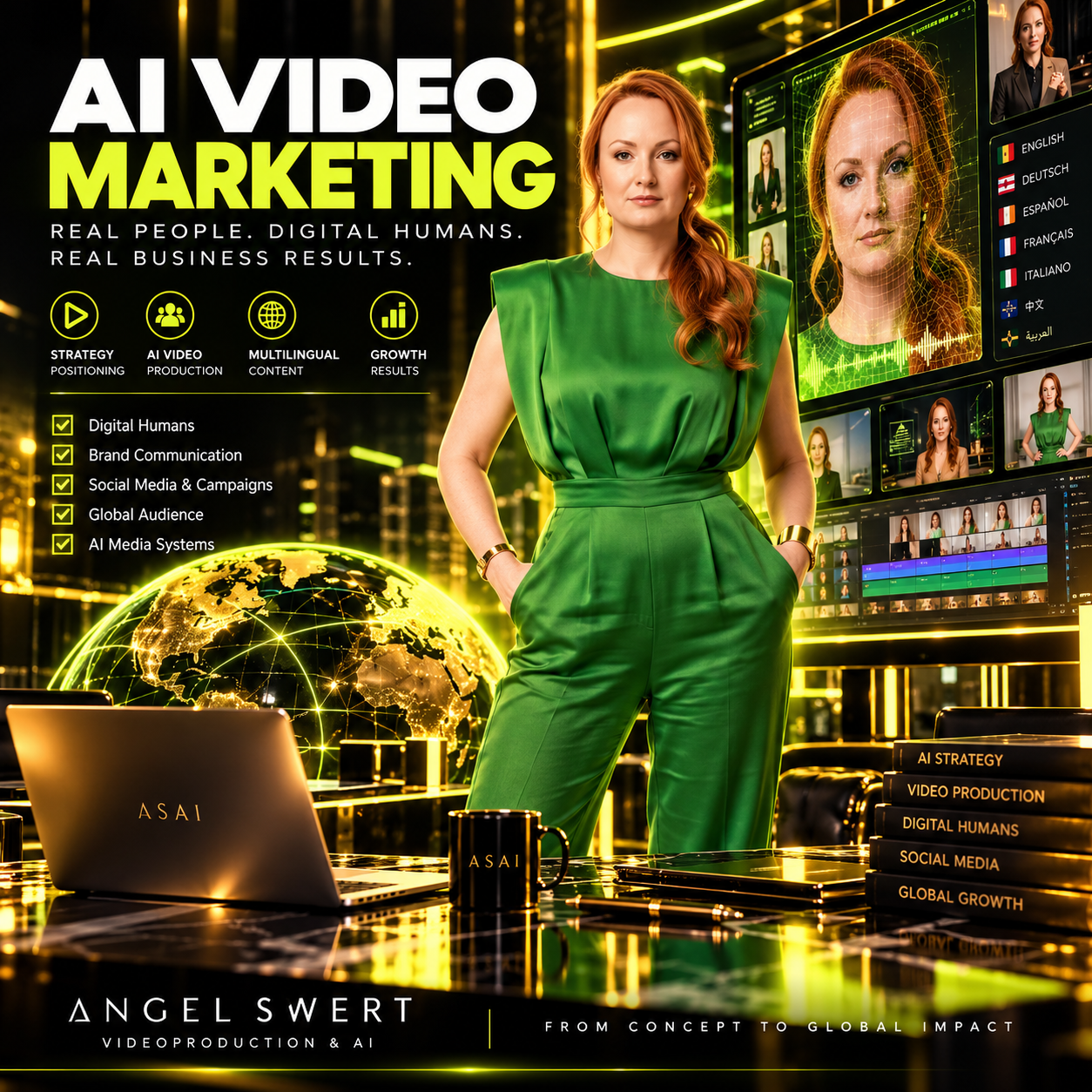
Six Years with AI Avatars: What Futurists Predict vs. What We Already Know
From our hands-on experience with HeyGen to the future of Digital Humans, AI video production and intelligent media systems.
Six Years with AI Avatars: What Futurists Predict vs. What We Already Know
The world is predicting a future of AI-generated films, interactive digital humans and personalized virtual worlds. But what happens when you have already spent six years studying and working with AI avatars?
For the past six years, I have been exploring the development of AI avatars and their potential to transform digital communication.
Today, at Angel Swert Videoproduction & AI, we are no longer asking whether AI-generated presenters can work.
We have already tested HeyGen, explored Digital Human production, experimented with multilingual video and studied how AI can become part of a structured media workflow.
And what we are seeing is much more interesting than simply replacing a person in front of a camera.
We are witnessing a transformation in how digital content can be created, managed, localized and delivered.
At the same time, futurists are making increasingly radical predictions.
Some suggest that traditional social media will disappear. Others believe people will stop watching films created by someone else and instead generate their own interactive stories.
But how much of this future is already real?
And how much remains speculation?
1. Six Years of AI Avatars: What Has Actually Changed?
When I began exploring AI avatars around 2020, the possibilities were far more limited than they are today.
The early attraction was straightforward: could we create a digital presenter without organizing a traditional video shoot every time?
Over the following years, the technology evolved.
Digital presenters became more realistic. Voice synthesis improved. Multilingual video became more accessible. Character creation and animation opened new creative possibilities.
Today, platforms such as HeyGen demonstrate how much this category has developed.
We have tested HeyGen in practice, working with AI avatars and examining the possibilities of multilingual content, digital identity and video production.
The experience has reinforced an important conclusion.
An AI avatar is no longer interesting simply because it can speak. Its value depends on what we build around it.
A digital presenter without a strategy is just another video format.
A recognizable Digital Human, supported by creative direction, approved content, production workflows and a clear business purpose, can become a much more valuable communication asset.
That is the direction we are exploring at Angel Swert.
2. HeyGen: From an AI Video Tool to a Business Production Workflow
One of the most significant changes we have observed is the growing importance of production systems.
Creating one AI video is relatively straightforward.
Producing a consistent series of videos across different topics, languages, formats and distribution channels is a different challenge.
In our work with HeyGen, we have explored the practical relationship between avatar identity, scripting, voice, localization and final production quality.
The technology makes new workflows possible.
But it does not eliminate the need for human judgment.
A business still needs to decide what it wants to communicate, which visual identity represents its brand and how the final content should be reviewed.
This is where I see the real evolution of AI video.
The future is not simply faster generation. It is more structured, scalable and controlled production.
And international businesses are already moving in this direction.
3. What Global Companies Are Already Doing
While analysts debate the future of AI-generated media, companies are implementing AI video in everyday business operations.
According to customer stories published by HeyGen:
Miro reports a tenfold increase in video production speed, supporting scalable learning content.
Workday reports reducing localization timelines from months to hours for projects involving multiple languages.
Würth Group uses AI-powered video for multilingual training and internal communication.
Publicis Groupe used AI avatar technology as part of a project creating 100,000 personalized employee messages.
These are company-reported results, not universal industry benchmarks.
Nevertheless, they illustrate an important point.
Businesses are not waiting for a hypothetical future in which Digital Humans become useful.
They are already applying AI video to training, communication, localization and personalized content.
The economic opportunity is becoming clearer.
Companies do not necessarily need more videos.
They need communication processes that are easier to maintain, update and scale.
Source: HeyGen Enterprise Customer Stories
Source: Publicis Groupe AI Video Project
4. Will AI Replace YouTube, Social Media and Traditional Films?
This is where I disagree with some of the more radical predictions.
The idea is fascinating.
Imagine describing a story to an AI system and watching it create a personalized film.
Imagine entering that story, interacting with its characters and changing the direction of the narrative.
Research into interactive world models suggests that elements of this vision are technically possible.
For example, Google's DeepMind introduced Genie 3, an experimental model capable of generating navigable environments in real time.
But these environments still face important limitations involving interaction duration, consistency and complex character behavior.
A research demonstration is not the same as a commercially mature entertainment ecosystem.
Source: Google DeepMind — Genie 3
More importantly, I question the assumption that people will stop valuing stories created by others.
We do not watch films only because we cannot create our own.
We watch them because we appreciate imagination, storytelling, recognizable characters and shared cultural experiences.
AI may change how these experiences are produced and consumed.
But it does not automatically eliminate the value of human creativity.
My expectation is not the disappearance of traditional media, but the emergence of hybrid media experiences.
People may continue watching films while also interacting with characters, exploring personalized storylines and participating in digital worlds.
The media industry may evolve without abandoning everything that made it valuable.
5. What About AI Content on YouTube?
Another recurring prediction is that social media platforms will eventually prohibit AI-generated content.
Current YouTube policies do not support a general ban.
YouTube permits AI-assisted content, while applying rules concerning originality, mass-produced content and disclosure of realistic synthetic media.
In 2026, the platform also expanded the visibility of AI content labels.
This suggests a different direction.
Platforms are developing ways to distinguish responsible AI production from misleading or low-value content.
For professional creators, the challenge is not simply whether AI is allowed.
It is whether their work provides recognizable creative, informational or entertainment value.
Source: YouTube — AI Content Disclosure
Source: YouTube — Monetization Policy Clarification
6. The Next Evolution: From Digital Human to Interactive AI System
This is the development I find most interesting.
Today, many Digital Humans communicate through pre-produced video.
A script is prepared, a voice is generated, the avatar presents the information and the final video is published.
But what happens when the Digital Human becomes connected to an AI agent?
Imagine a company using a digital representative that can answer questions about approved products, guide employees through training materials or provide information in different languages.
Instead of creating a new video for every possible question, the company could combine prepared content with controlled interactive responses.
That would represent a meaningful change.
The Digital Human would no longer function only as a presenter.
It could become an interface between people and an organization's knowledge.
However, this introduces new responsibilities.
Accuracy, access permissions, data protection, identity authorization and human oversight become essential.
A realistic face is not enough.
An intelligent Digital Human needs an equally intelligent system behind it.
7. Why Creative Direction Will Become More Valuable
There is another side to this transformation.
As AI video generation becomes more accessible, the ability to produce an attractive image may no longer be a strong competitive advantage by itself.
Many companies will have access to similar technologies.
What will distinguish their content?
I believe it will be the combination of creative direction, recognizable identity, storytelling and consistent execution.
A premium visual result requires decisions about composition, atmosphere, movement, lighting, pacing and emotion.
A recognizable Digital Human requires consistency across different scenes and campaigns.
A useful business video requires a message that serves a specific objective.
And a scalable media operation requires more than a collection of disconnected AI tools.
The value is shifting from generating individual assets to designing the system and creative identity behind them.
That is why I do not see the future of AI video as a competition between humans and machines.
I see it as a transformation of creative work.
8. My Perspective: What Comes Next for AI Media?
After six years of exploring AI avatars and testing how platforms such as HeyGen can support modern video production, I see three developments worth watching.
First, AI video will continue becoming more accessible.
Second, Digital Humans will increasingly be connected to business workflows, knowledge systems and interactive applications.
Third, media experiences may become more personalized and participatory.
But these developments will not happen at the same speed.
Generating a video is already commercially accessible.
Building a reliable AI-powered communication workflow requires more planning.
Creating persistent, complex and economically viable personalized digital worlds remains a much larger challenge.
I believe the companies that understand these differences will make better technology decisions.
They will not invest in every prediction.
They will identify which capabilities solve real problems today and which opportunities deserve further research.
9. What This Means for Angel Swert Videoproduction & AI
At Angel Swert, we are interested in more than the technology behind an AI avatar.
We are exploring how Digital Humans, AI-powered video production, multilingual communication, creative storytelling and automation can work together.
Our practical experience with HeyGen is part of that journey.
It helps us understand both the possibilities and the limitations of current tools.
We are also exploring a broader direction: moving from individual AI videos toward structured AI media systems.
The long-term opportunity is not simply to produce more content.
It is to make content more reusable, consistent, adaptable and valuable to the businesses and audiences it serves.
I do not believe we need to wait for 2035 to begin building that future.
We can already test the technologies, study their economics and develop practical workflows today.
But I also believe that the future should be built on evidence, not excitement alone.
After six years with AI avatars, my biggest lesson is this: the most important innovation is not the digital face. It is the intelligence, creativity and responsibility behind it.
And that is where I believe the next chapter of AI media begins.
Angel Swert
Founder, Angel Swert Videoproduction & AI
AI Video Production | Digital Humans | Creative Direction | AI Media Strategy
Explore Angel Swert Videoproduction & AI