
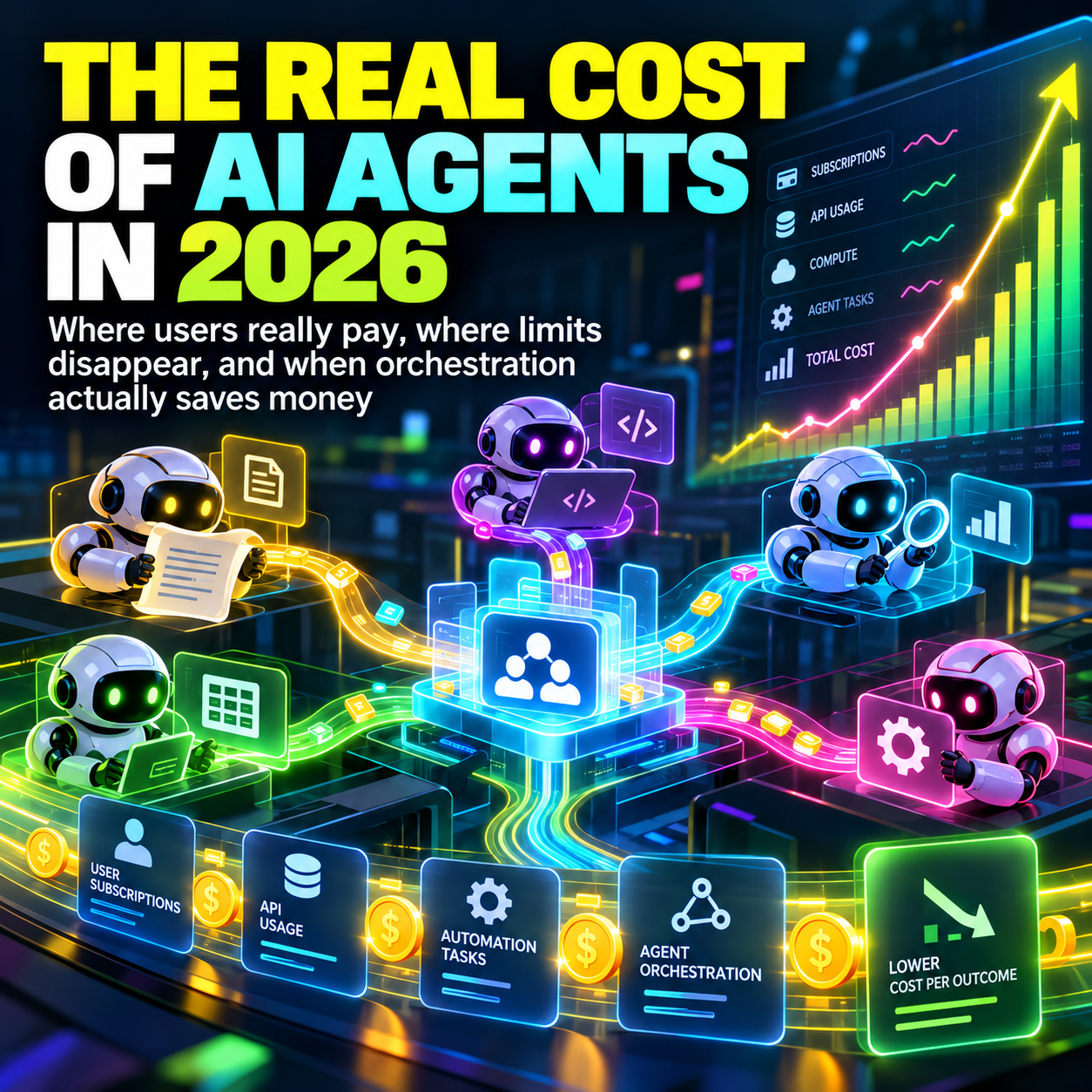
The Real Cost of AI Agents in 2026: Tokens, Limits & Savings
AI Subscriptions, API Pricing, Hidden Costs, and the Economics of Multi-Agent Automation
The Real Cost of AI Agents in 2026: What You Actually Pay For — and When Orchestration Saves Money
Why the cheapest AI model is not always the most economical choice, why subscriptions can be misleading, and how to build AI systems that deliver more value without wasting your budget.
By Angel Swert | Angel Swert Videoproduction & AI | October 19, 2026
The AI Industry Has a New Economic Problem
Artificial intelligence is becoming more capable, more autonomous and increasingly integrated into everyday business operations.
We are moving beyond simple chatbots toward AI agents that can research information, analyze documents, write code, manage workflows, interact with external tools and coordinate other AI systems.
But something important happens when AI stops answering one question and starts completing an entire project.
The economics change.
A chatbot might produce an answer in a few seconds. An AI agent may perform dozens of intermediate steps before delivering a result.
It may retrieve documents, call external services, generate code, review its own work, encounter an error, retry an operation and delegate parts of the task to another model.
Every one of those actions can introduce additional costs.
And this is where the popular conversation about "saving AI tokens" becomes too simplistic.
The real question in 2026 is no longer how to buy the cheapest tokens. It is how much it costs to produce one reliable, useful business result.
From my perspective as a creator working with AI video production, digital humans, content systems and automation, this distinction is fundamental.
The future of AI is not just about powerful models. It is about designing systems that make economic sense.
1. The First Misunderstanding: An AI Subscription Is Not the Same as API Access
Most users begin with an AI subscription.
They pay a fixed monthly amount to access models through platforms such as ChatGPT or Claude.
This creates the impression that AI computing power has a predictable monthly price.
But a subscription is not an unlimited supply of transferable computing resources.
There are two fundamentally different ways to pay for AI.
Subscription-based access
A subscription provides access to specific AI products under the conditions of a chosen plan.
Usage limits may depend on the model, workload, product features and provider policies.
A subscription can offer excellent value for someone who uses AI intensively, but the amount of usage available is not necessarily fixed forever.
API-based access
An API allows a developer or application to interact with AI models programmatically.
Instead of paying only a monthly platform fee, users typically pay according to consumption.
Depending on the service, charges may include input tokens, output tokens, cached context, tool usage, computing resources and other features.
These are separate billing systems.
For example, OpenAI explicitly states that ChatGPT subscriptions and OpenAI API billing are managed separately.
A paid ChatGPT subscription does not automatically include unlimited API usage.
Source: OpenAI — Managing ChatGPT and API Billing
This matters particularly for businesses connecting AI to their own applications.
A workflow that appears inexpensive inside a consumer subscription may have a very different cost structure when deployed through an API.
2. What the SemiAnalysis Research Actually Reveals
On October 5, 2026, SemiAnalysis published an investigation titled Anthropic Subscriptions Offer 5x+ More Value Than OpenAI.
The researchers compared usage limits across subscription plans from multiple AI companies, including OpenAI, Anthropic and several other providers.
Their approach was particularly interesting.
Rather than comparing subscription prices alone, they estimated how much the permitted usage would cost if purchased at the corresponding API rates.
This is called API-equivalent value.
In specific model and workload comparisons, the researchers found that Anthropic subscriptions offered approximately five times the API-equivalent value of comparable OpenAI subscriptions.
The study also documented changes to subscription limits and demonstrated why subscription value can fluctuate even when the monthly fee stays the same.
Source: SemiAnalysis — Anthropic Subscriptions Offer 5x+ More Value Than OpenAI
However, there is an important distinction.
API-equivalent value is not the amount of money a user receives, nor is it necessarily the provider's actual cost of delivering those computations.
It is an economic comparison based on published API prices, measured usage limits and workload assumptions.
A subscription theoretically offering thousands of dollars in API-equivalent usage does not mean every subscriber receives or consumes that value.
The lesson is not that AI companies are giving away free money. It is that subscription prices and API consumption prices represent two different economic models.
For businesses, the practical conclusion is straightforward: subscription value should be evaluated against actual usage patterns, not promotional claims or headline comparisons.
3. Where Does the Money Go When an AI Agent Works?
To understand AI agent economics, we need to look at the complete workflow.
Consider a simple request:
"Analyze customer feedback, identify the main complaints, compare competing products and recommend three improvements."
To a human, this sounds like one task.
To an autonomous AI system, it may involve multiple operations.
First, an agent retrieves customer feedback.
Then it reads and classifies the information.
Next, it searches for relevant competitor data, evaluates the evidence, generates recommendations and verifies the final output.
If the system uses several specialized agents, the workload may be distributed across multiple models.
The final answer is only a small part of what happened.
Input tokens: paying for what the model reads
Input tokens may include the user's request, system instructions, conversation history, retrieved documents, tool definitions and tool responses.
A model that repeatedly receives a large context may consume substantial input tokens before generating a useful answer.
Output and reasoning tokens: paying for what the model produces
Output tokens cover generated results and, for supported reasoning models, internal reasoning tokens.
According to OpenAI's agent documentation, reasoning tokens are billed as output tokens.
A short visible answer does not necessarily indicate low total output-token usage.
Tool calls and execution
An AI agent may use web search, file search, code execution, external APIs or sandbox environments.
Some tools have separate charges.
External services may also introduce independent billing.
Retries and verification
Agents are not perfectly reliable.
Failed operations, malformed outputs, unnecessary tool calls and repeated attempts can increase the cost of completing the same task.
A workflow that succeeds on its first attempt may be much cheaper than one requiring repeated corrections.
Source: OpenAI — Agent Observability and Usage
This leads to a more useful way of measuring AI efficiency:
Total task cost = Model execution + Orchestration + Tools + Infrastructure + Verification + Rework.
For subscription-based workflows, this also includes allocated subscription costs and the opportunity cost of limited usage capacity.
The real cost of AI agents is therefore not just a token price.
It is the cost of completing the entire operational process.
4. How Different Are AI Model Prices in 2026?
The differences are significant.
Consider two official OpenAI models: GPT-6 Astra, positioned for demanding reasoning tasks, and GPT-6 Luna, designed for efficient, cost-sensitive workloads.
As of October 19, 2026, OpenAI lists the following standard API prices for short-context processing:
| Model | Input per 1M tokens | Output per 1M tokens | |---|---:|---:| | GPT-6 Astra | $10.00 | $50.00 | | GPT-6 Luna | $0.10 | $0.50 |
Sources: GPT-6 Astra and GPT-6 Luna.
For these token categories, Astra is priced at 100 times Luna's standard rate.
That is a substantial difference.
But it would be incorrect to conclude that Luna makes every business task 100 times cheaper.
Different models may require different numbers of steps, produce different amounts of output and achieve different levels of accuracy.
A cheaper model that consistently makes mistakes can become expensive when its work requires substantial correction.
The relevant question is whether the less expensive model can achieve the required quality for a specific part of the task.
A transparent cost calculation
Let us consider a hypothetical workload involving:
- 1 million total input tokens
- 100,000 total output tokens
- Processing distributed across multiple requests, each below the long-context pricing threshold
- No cached-token discounts, special processing tiers, separate tool charges or retries
If GPT-6 Astra handles the entire workload:
Input: 1,000,000 × $10 / 1,000,000 = $10.00
Output: 100,000 × $50 / 1,000,000 = $5.00
Total: $15.00
If GPT-6 Luna handles the same token volumes:
Input: $0.10
Output: $0.05
Total: $0.15
This is a theoretical API billing comparison, not a demonstration that both models would deliver equivalent results.
Now imagine a third approach.
Astra plans and validates the work, while Luna handles the large repetitive processing stage.
Suppose the Luna stage costs $0.15, while Astra consumes an additional 40,000 input tokens and 2,000 output tokens for coordination and validation.
Astra coordination costs $0.50.
The combined modeled cost becomes:
$0.15 + $0.50 = $0.65.
Compared with the $15 Astra-only baseline, the theoretical reduction is approximately 95.7%.
This example demonstrates the potential importance of architecture.
It does not establish a typical real-world saving. The quality, actual token volumes, cache charges, execution overhead and number of retries must be measured before making a business claim.
And that brings us to orchestration.
5. Multi-Agent Orchestration: When Does It Actually Save Money?
Orchestration is the process of coordinating different tasks, tools or AI agents within a single workflow.
Think of it as managing a production team.
A senior specialist makes complex decisions, while other specialists perform clearly defined work.
An AI system can use a similar structure.
One model may plan the task.
Another model extracts information.
A third validates the results.
The coordinating agent combines the outputs into the final deliverable.
OpenAI's documentation confirms that multi-agent systems can delegate work to independent subagents, each operating with its own context.
But it also explicitly warns that adding subagents can increase token usage.
Source: OpenAI — Multi-Agent Systems
That warning matters.
More agents do not automatically mean greater efficiency.
Orchestration is most attractive when a workflow contains large amounts of repeatable work that can be assigned to an appropriately capable, lower-cost model.
It may also improve execution speed when independent tasks can run in parallel.
However, creating separate agents to perform three simple consecutive actions may introduce unnecessary overhead.
The strongest orchestration strategies begin with task decomposition, not agent multiplication.
Example: An AI editorial research system
Imagine a YouTube channel receiving 1,000 comments across multiple videos.
The goal is to identify the strongest ideas for future content.
A powerful reasoning model can establish an editorial classification framework: what constitutes a meaningful audience question, which requests reflect recurring demand and which comments are irrelevant.
A smaller model can then categorize the comments according to those rules.
The system can retain comment IDs, group similar requests and flag uncertain classifications.
Finally, the stronger model reviews the aggregated results and proposes content directions.
A human editor makes the publishing decision.
This is a practical architecture because the expensive reasoning is concentrated where editorial judgment is needed.
But for a one-time dataset of modest size, even this architecture might be unnecessary.
A single model, a simple script or a batch-processing job could accomplish the same work with less complexity.
The correct decision requires testing.
6. The Overlooked Cost Optimizations: Caching and Batch Processing
AI model selection receives most of the attention, but two other techniques can materially change API economics.
Prompt caching
AI applications frequently send the same instructions, reference material and tool definitions with successive requests.
Prompt caching allows supported models to reuse processing from matching prompt prefixes.
OpenAI documents cached-input discounts of up to 95%, depending on the model.
However, newer models may also charge a premium for writing reusable context into the cache.
For example, OpenAI's GPT-6 family uses cache-write pricing and reduced cache-read rates.
The benefit therefore depends on how often the same context is reused and whether caching conditions are met.
An application that continuously changes its entire prompt may receive fewer cache benefits than a system with stable instructions and changing task data.
Source: OpenAI — Prompt Caching
Batch processing
Not every AI task needs an immediate response.
Customer-feedback classification, document tagging, large-scale evaluations and many content-analysis jobs can run asynchronously.
OpenAI's Batch API offers a 50% discount compared with standard synchronous API processing, subject to its supported models and processing conditions.
Batch processing uses a separate capacity pool and has a documented completion window of up to 24 hours.
Source: OpenAI — Batch API
For many businesses, this raises